What kinds of slabs do you pour?
Most of the slabs we pour in the city fall into a handful of groups:
- Shed pads. A flat base for a prefab or stick-built shed, sized a few inches past the walls so rain drips onto gravel, not the sill.
- Detached garage floors. Thicker, with thickened edges where the walls bear and a slight pitch to the door so melting snow drains out.
- Equipment pads. Standby generators, heat pump condensers and AC units need a level base that will not tilt.
- Workshop and hobby slabs. A base for a backyard studio, a greenhouse or a gazebo.
- Replacement floors. Breaking out a cracked, heaved floor in an old garage and pouring a new one inside the existing walls.
How is a slab built so it lasts?
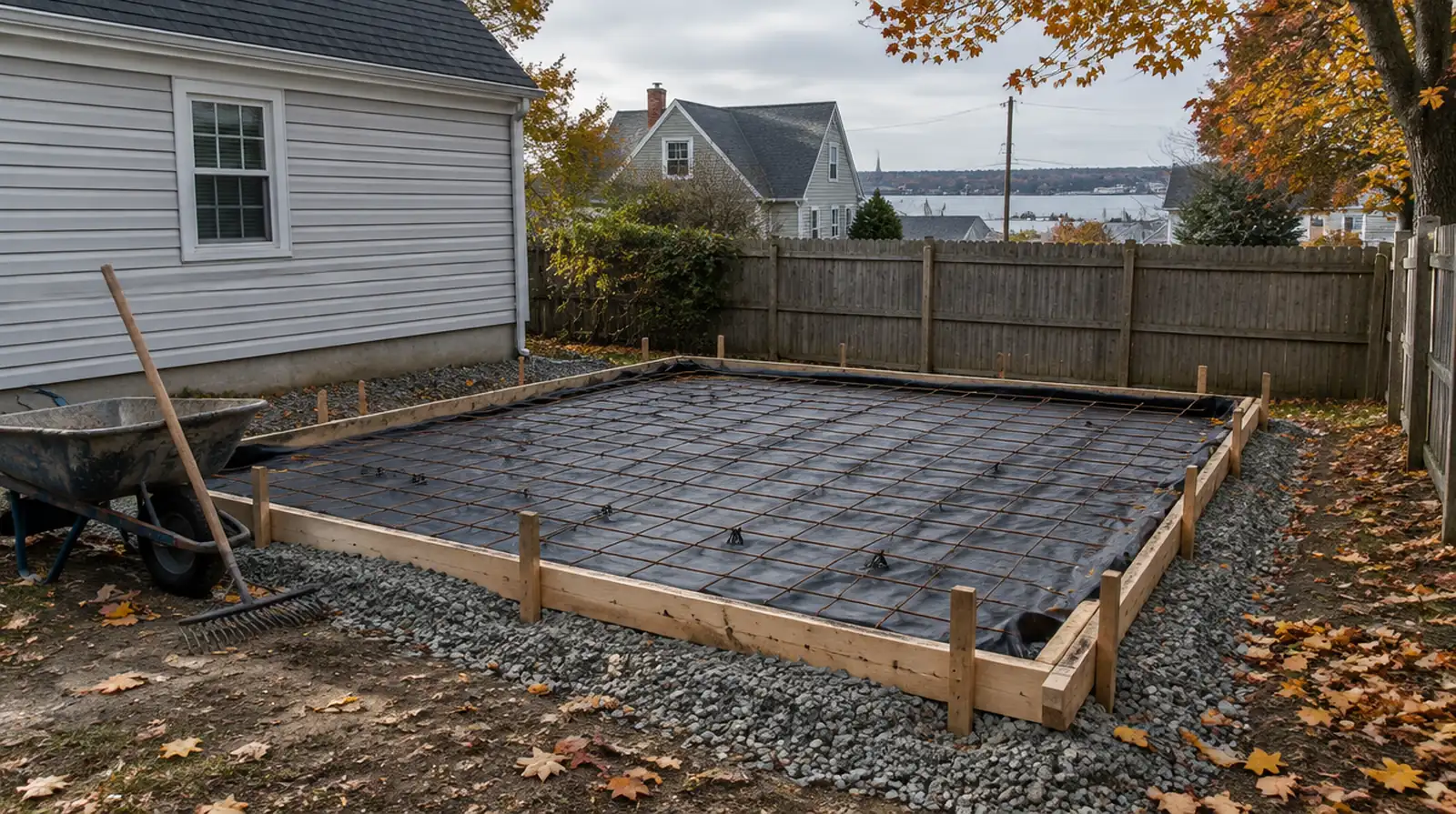
The concrete gets the attention, but the ground under it does most of the work. We strip the topsoil and sod, which rot and settle, and dig down to firm subsoil. Then four inches or more of crushed stone go in, spread in layers and compacted with a plate tamper. Forms are set to string lines and checked for square by measuring the diagonals. Wire mesh or rebar goes in on chairs so it ends up in the middle of the slab, where it does its job, not lying on the bottom.
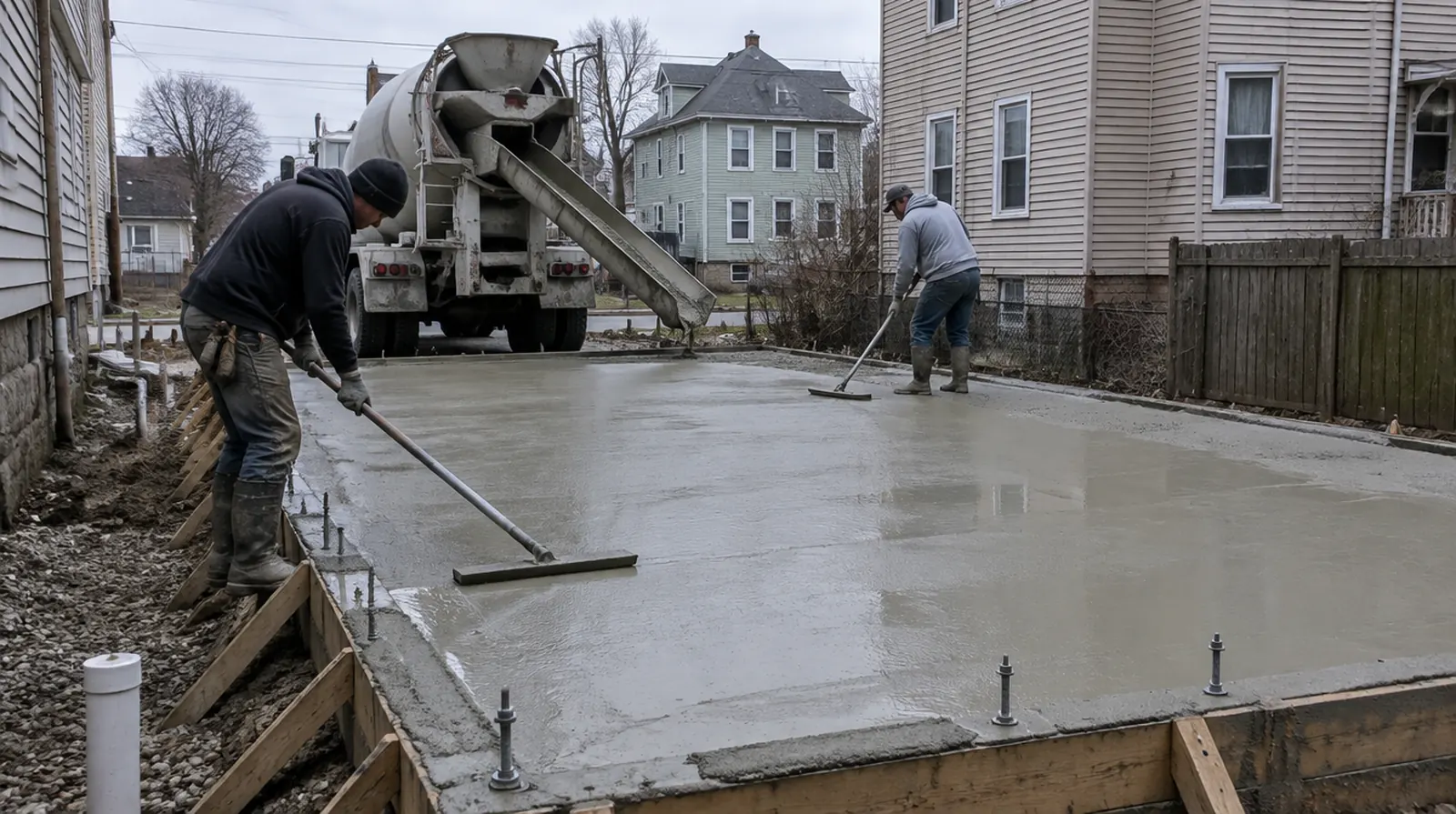
After the pour, the surface is floated and finished, and control joints are cut in a grid. Concrete shrinks as it cures and it will crack. Joints give the crack a straight, planned place to happen. Shed pads usually get a broom finish. Garage floors get a smoother trowel finish that is easier to sweep.
What does Rhode Island weather do to a slab?
Winters here swing above and below freezing over and over. Every time water soaks into the ground or the concrete surface and freezes, it expands. A slab poured straight on clay or loam with no stone base will move with that frost. Salt makes things worse. A garage floor sees salty slush dripping off the car all winter, and that brine eats at the surface. For garage slabs we use an air-entrained mix, which holds microscopic bubbles that give freezing water room to expand, and we recommend a penetrating sealer after the slab cures.
Lots near the Ten Mile River, Watchemoket Cove or the low parts of Riverside can hold water after heavy rain. On wet sites, we raise the slab a little above grade and slope the ground around it away, so water does not pool against the shed or garage walls.
Do I need a permit?
In East Providence, detached sheds and garages count as accessory structures. They generally need a building permit and zoning review, and there are limits on how many you can have, how tall they can be and how close they sit to the house and property lines. A building that breaks those rules may need relief from the zoning board. Check the current rules with the city's building and zoning office before you buy a shed or sign a garage contract, and keep the approved plot plan handy so we can pour the slab in the right spot.
What does a concrete slab cost?
Price depends mostly on square footage and thickness. Then access: a backyard that a concrete truck can back into is cheaper than one where every load has to go in by wheelbarrow or pump. Digging out old concrete or a lot of fill adds labor. Thickened edges, rebar, a vapor barrier under a garage floor and anchor bolts all add a bit. We give a fixed written price once we have seen the site.
Slab questions
How thick should a shed slab be?
Four inches works for most garden sheds. Garages and anything holding a car, a tractor or heavy tools should be thicker, with heavier steel.
Can I put the shed on it right away?
Light walking is fine after a day or two. Wait about a week before setting a heavy building on it, and longer before driving a car onto a new garage floor.
Can you pour in winter?
We can when the ground is not frozen. Concrete cannot go onto frozen soil, and new slabs need blankets on cold nights.
Need a path from the house to the new shed? Take a look at our walkway work. For a slab you plan to sit on rather than build on, see concrete patios.
Planning a shed or garage?
Call us before you order the building. We will measure, look at the ground and give you a written price for the slab.
Call (401) 320-4188